
Deep Guide to DISC Personality Test: Styles, Insights, and Real-World Value
DISC Personality Assessment Test
Get StartedWhat the DISC Framework Is and Why It Still Matters
DISC offers a clear, behaviorally focused lens that describes how people tend to approach problems, pace, people, and procedures. Originally grounded in Marston’s work, the model has evolved into a pragmatic toolkit used in hiring, coaching, conflict resolution, and change management. Rather than categorizing people rigidly, it maps tendencies along four continua, which reveals how someone prefers to communicate, make decisions, and respond under pressure. Organizations adopt this framework because it improves clarity, reduces friction, and accelerates collaboration across teams with different rhythms and priorities.
In practice, the model thrives when it is translated into everyday actions, such as adapting tone, choosing the right meeting format, or sequencing information for decision-makers. Within this context, DISC personality assessment provides a shared vocabulary for noticing behavioral cues, interpreting them constructively, and aligning approaches with collective goals. Accuracy improves when results are DISCussed as probabilities rather than absolutes, and when context such as role demands, culture, and incentives is considered thoughtfully. The payoff is not just self-knowledge, but also practical agreements about how to work together with less friction and more momentum.
A critical insight is that no single style is inherently superior, and balanced teams often outperform homogenous groups because they integrate complementary strengths. Beyond labels, the phrase DISC personality serves as shorthand for clusters of observable behaviors that can flex with experience, feedback, and situational pressure. Leaders who model flexibility help their teams normalize adaptation, which in turn encourages constructive candor, faster decisions, and resilient execution. When people can anticipate one another’s needs, the group spends less energy decoding signals and more effort on creating value for clients and stakeholders.
- Use the framework to illuminate choices, not to fix identities.
- Observe behavior in context and over time for better reliability.
- Translate insights into concrete agreements and team norms.
- Revisit DISCussions after projects to refine working practices.
Understanding the Four Styles and Their Dynamics
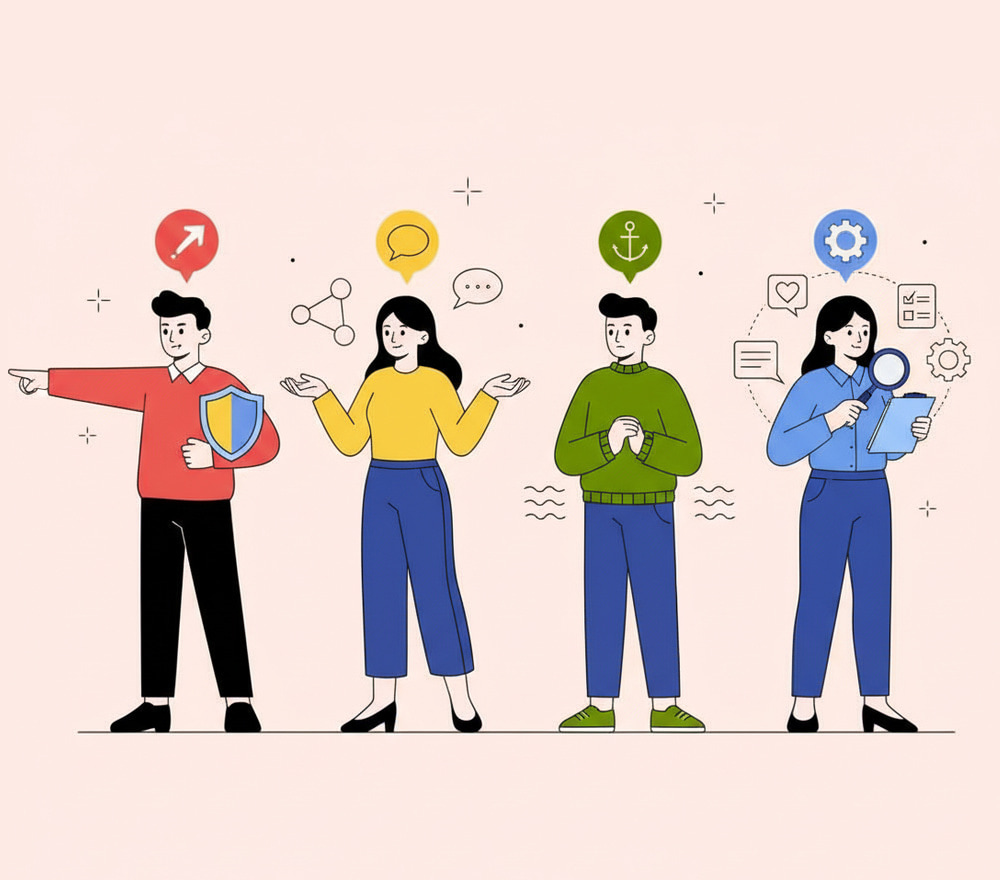
Each DISC style emphasizes different priorities, and the real magic shows up in the interactions between them. High-D energy is decisive and competitive; high-I energy is expressive and social; high-S energy is steady and supportive; high-C energy is analytical and quality-focused. Blended patterns create nuance, like fast yet thorough D/C combinations, or people-centered S/I pairings that elevate harmony and engagement. Because styles are tendencies rather than rules, the most effective development programs emphasize choice, practice, and situational awareness.
When teams map their patterns collectively, the conversation shifts from personal critiques to shared problem-solving. In guided debriefs, DISC personality profiling translates preferences into visible team heatmaps that reveal blind spots, pressure points, and untapped synergies. That visibility encourages agreements about meeting flow, decision gates, and communication channels, which minimizes friction without sacrificing speed. The outcome is a group that reads context faster and coordinates with fewer misunderstandings, especially during high-stakes initiatives or rapid change.
| Style | Core drives | Communication cues | Under stress | Growth tips |
|---|---|---|---|---|
| D (Dominance) | Results, control, speed | Direct, brief, action-first | Impatience, bluntness | Invite input, pace empathy |
| I (Influence) | Connection, enthusiasm | Story-driven, optimistic | Overpromising, distraction | Anchor commitments, follow-through |
| S (Steadiness) | Stability, cooperation | Calm, patient, supportive | Avoiding conflict, inertia | Initiate change, voice boundaries |
| C (Conscientiousness) | Accuracy, standards | Structured, detail-rich | Overanalysis, rigidity | Prioritize, share drafts earlier |
After completing an instrument, a typical DISC personality profile summarizes intensity for each dimension, outlines likely communication habits, and highlights stress triggers along with recovery strategies. Good facilitation invites participants to reality-test those insights with recent situations and to identify two or three experiments that could improve outcomes quickly. Over time, these micro-adjustments compound into smoother collaboration, faster decisions, and clearer handoffs. The result is a shared cadence that respects differences while pushing toward measurable results.
Benefits for Individuals, Teams, and Leaders
The model’s versatility makes it valuable from onboarding to executive strategy. Individuals gain language to explain their needs without sounding defensive, which reduces misinterpretation and builds credibility. Teams build norms around clarity, timing, and decision methods, so meetings become shorter and more decisive. Leaders use style data to sequence change initiatives, adjust coaching approaches, and align talent with the work that fits their energy. The compounding effect is a culture that communicates better, wastes less time, and achieves more with fewer surprises.
For hiring or mobility decisions, a calibrated DISC personality profile assessment supports consistency by comparing role requirements with observable behaviors and preferred work conditions. When a function needs high compliance to standards, managers can set expectations explicitly and provide examples that anchor what “good” looks like for that environment. In turn, candidates and employees can DISCuss fit with more precision, which leads to better onboarding, clearer roadmaps, and lower ramp times for complex roles.
In training contexts, structured DISC personality profile testing gives participants a safe way to explore differences, build empathy, and practice adaptation in realistic simulations. Programs that mix role-play, peer feedback, and retention boosters like job aids or reminders tend to stick better, because they create frequent, small opportunities to try new behaviors. Over quarters, these cycles produce higher engagement, fewer escalation loops, and steadier performance under pressure. That stability frees leaders to focus on strategy rather than constant firefighting and rework.
- Reduce miscommunication by aligning message structure to audience preferences.
- Enhance coaching by matching feedback cadence and level of detail.
- Strengthen change adoption by sequencing stakeholders thoughtfully.
- Improve customer experience by mirroring client pacing and priorities.
How to Take an Assessment and Interpret Results Responsibly
Before starting, clarify your purpose: self-awareness, team development, hiring alignment, or leadership coaching. That intent helps you choose the right instrument, set expectations, and conduct a debrief that connects insight to action. Answer items quickly and honestly, focusing on typical behavior rather than idealized images of yourself. After receiving results, confirm resonance with colleagues or mentors who observe your work under pressure, and convert insights into a few specific agreements or rituals.
For light exploration, a brief DISC personality quiz can introduce terminology and reveal directional tendencies before you commit to a more comprehensive experience. Ethical use always avoids medical or clinical claims and frames outputs as patterns that can flex with practice and context. If your organization requires formal benchmarking, a validated DISC personality types test provides reliability evidence, clear scoring logic, and documentation that meets audit needs. Whatever you choose, the most important step is translating insight into behaviors that teammates can see and appreciate consistently.
- Schedule a debrief within 48 hours to maintain momentum and clarity.
- Pick two micro-behaviors to pilot for two weeks, then review outcomes.
- Ask a colleague to observe one meeting and give precise feedback.
- Document team norms that reflect what you learned and revisit quarterly.
From Insight to Action: Practical Applications
Transforming awareness into performance requires small, repeatable experiments. Sales teams can tailor DISCovery questions to client pacing, while support teams can script escalation pathways that fit various urgency levels. Product groups can plan sprints with flexible collaboration windows for fast thinkers and deeper focus blocks for analytical contributors. When these adaptations are made visible, accountability improves and stress declines because people know what to expect and how to contribute effectively.
Budget-conscious facilitators sometimes start with a free DISC personality test as a primer that familiarizes participants with vocabulary and gives a quick sense of likely preferences. Early familiarity helps reduce defensiveness, which opens the door to more nuanced conversations about trade-offs and shared work design. When piloting a new workshop, a vendor’s DISC personality test free model can help estimate interest, adjust pacing, and calibrate the eventual investment. After the pilot, teams can decide whether to adopt a fuller solution that supports measurement across cohorts and time.
- Codify handoff checklists that reflect different thresholds for detail.
- Design meeting agendas with varied segments to suit multiple styles.
- Map risk points where styles clash and create preplanned mitigations.
- Capture wins that result from adaptation to reinforce ongoing practice.
Selecting the Right Tool and Comparing Options
Tool selection should weigh validity, reliability, documentation, language availability, and the quality of debrief resources. Some platforms specialize in enterprise analytics and cohort dashboards, while others prioritize simplicity and speed for small teams. Consider your use cases: coaching depth, hiring alignment, leadership pipelines, or customer-facing training. Also examine data privacy, integrations, and the vendor’s update cadence, since content freshness and support responsiveness will matter over the long term.
For learners who prefer sampling, certain providers offer a DISC personality types test free introduction that conveys basic style language without advanced scoring or norms. That approach can be helpful for community groups, student programs, or organizations testing feasibility before procurement. Where bandwidth is limited or connectivity is inconsistent, a printable DISC personality test free download can enable paper-based sessions with later digital entry, which preserves access for distributed teams. Over time, many groups graduate to more sophisticated platforms that add benchmarking, multi-rater inputs, and role-specific insights for sustained development.
- Match instrument depth to your decision risk and stakeholder expectations.
- Confirm that reports translate into practical, behavior-focused guidance.
- Evaluate facilitator training and support libraries before rollout.
- Plan for re-administration to track growth, not just a one-time snapshot.
FAQ: Common Questions About DISC
Does DISC measure personality or behavior?
DISC focuses on observable behavior and preferences rather than underlying clinical constructs. It aims to describe how someone tends to act, not to diagnose who they are. That practical focus makes it useful for workplace communication, team alignment, and everyday collaboration.
Can someone have more than one dominant style?
Yes, many people display blended patterns that shift with role demands and context. A person may present differently in sales meetings compared with analytical planning sessions. Recognizing this range enables more precise adaptation and prevents oversimplified labeling.
How accurate are results over time?
Results are generally stable when environments are consistent, yet they can shift with new responsibilities, culture changes, or deliberate practice. Reassessing after major transitions helps keep insights current. The most reliable approach is to pair data with real-world observation and feedback loops.
Is DISC appropriate for hiring decisions?
It can inform conversations about role fit and working conditions, but it should never be the sole basis for hiring. Combining structured interviews, work samples, and reference checks with style insights creates a fairer, more predictive process. Ethical use emphasizes job relevance and transparency.
What is the best way to apply insights after a session?
Translate findings into a handful of visible agreements and micro-behaviors, then test them in real meetings and projects. Solicit targeted feedback and review outcomes at set intervals to reinforce learning. This cadence converts theory into measurable performance improvements and healthier team norms.