
DISC Assessment: A Practical Guide to Understanding Behavior
DISC Personality Assessment Test
Get StartedWhat DISC Is and Why Organizations Care
The modern workplace moves fast, and teams succeed when people understand how to collaborate under pressure. A clear behavioral framework gives colleagues a common vocabulary for preferences, pace, and priorities, which reduces friction and boosts alignment. Rather than boxing people in, a good instrument illuminates patterns so that individuals can flex intentionally and communicate with less guesswork.
At a definitional level, the DISC assessment meaning comes from a century of behavioral research that maps four observable tendencies into a simple, teachable model. These observable patterns show up in meetings, emails, and negotiations, and they shape how we make decisions, manage conflict, and respond to change. Because the model is descriptive rather than predictive, it supports growth without labeling people as fixed types.
Beyond quick labels, the DISC assessment offers a shared language that reduces friction across teams. Practitioners often combine it with coaching and feedback routines so people can translate insights into daily habits. With the right rollout, even skeptical participants DISCover how subtle shifts, like adjusting detail level or pace, unlock collaboration.
- Leaders gain a blueprint for tailoring communication and expectations.
- Managers spot friction points before they become costly conflicts.
- Teams build psychological safety through clearer intent and fewer misunderstandings.
- Individuals learn when to dial up or down behaviors to fit the moment.
How the Model Works and the Core Dimensions
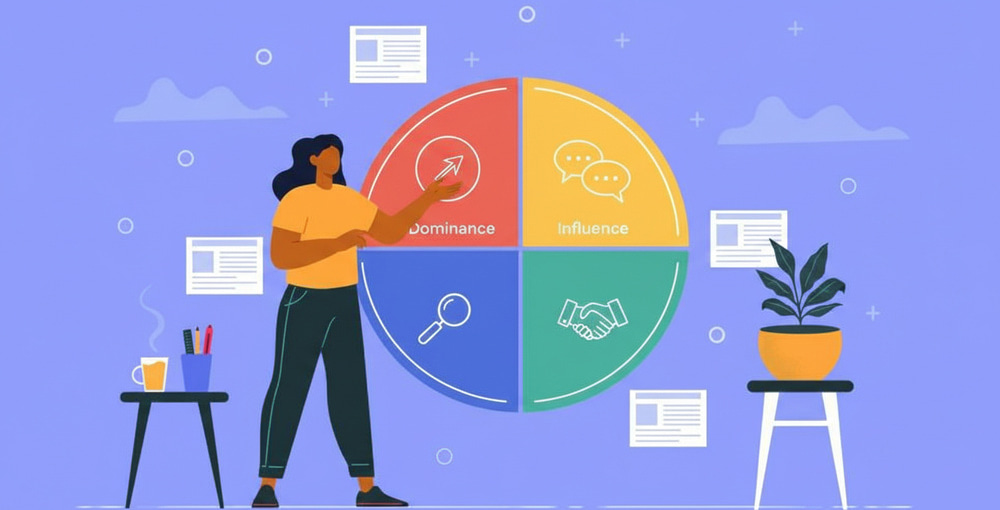
At the heart of the framework are four observable patterns often summarized as Dominance, Influence, Steadiness, and Conscientiousness. Each person shows a unique blend, and under stress or change, certain tendencies intensify. Rather than ranking people, the model invites participants to examine comfort zones, triggers, and blind spots, and to experiment with new behaviors in realistic scenarios.
When facilitators visualize tendencies, the DISC assessment wheel helps teams see spacing, clusters, and potential blind spots. The map reveals who pushes for speed, who advocates for harmony, who scrutinizes details, and who energizes brainstorming, which makes meeting design vastly more intentional. Seeing the spread on a visual map also normalizes differences and reduces unhelpful stereotyping.
From a newcomer’s perspective, the DISC assessment explained through stories and examples becomes practical fast. Case studies show how a detail‑oriented analyst and a fast‑paced salesperson can tailor handoffs to avoid dropped balls. Exercises such as role‑reversal practice teach teammates how to signal needs clearly and listen for intent, not just content.
- Dominance: direct, decisive, and energized by challenges.
- Influence: social, persuasive, and motivated by collaboration.
- Steadiness: patient, supportive, and focused on stability.
- Conscientiousness: analytical, precise, and quality‑driven.
Benefits, Use Cases, and Quick Comparisons
When behavioral insights move from paper to practice, organizations see tangible gains in speed, clarity, and morale. Managers use results to craft one‑on‑ones that fit each person’s cadence, while cross‑functional teams calibrate meeting flow to balance brainstorming with decision quality. Customer‑facing roles benefit from reading cues quickly and adapting tone, structure, and follow‑ups to match buyer preferences.
For busy executives, a crisp DISC assessment overview clarifies what the tool can and cannot predict. It is not a measure of intelligence or values; it spotlights observable behavior, which makes it ideal for coaching, onboarding, and conflict prevention. Used ethically, it enhances equity by focusing on interaction patterns rather than subjective impressions.
| Style | Core Drives | Communication Tips |
|---|---|---|
| Dominance (D) | Results, speed, autonomy | Be brief, focus on outcomes, offer choices |
| Influence (I) | Connection, visibility, optimism | Be upbeat, brainstorm options, acknowledge ideas |
| Steadiness (S) | Stability, collaboration, support | Be patient, explain changes, provide reassurance |
| Conscientiousness (C) | Accuracy, logic, standards | Be precise, share data, allow time to review |
After scoring, a tailored DISC profile assessment report outlines strengths, stress responses, and growth cues. Many teams codify working agreements based on these insights, such as how to escalate risks, how to request details, and how to close loops after decisions. Over time, the shared language reduces rework and makes feedback less personal and more purposeful.
Leading with DISC: Culture, Coaching, and Change
High‑performing cultures translate insight into systems, not just workshops. Leaders who model adaptable communication set the tone for productive disagreement and inclusive planning. Coaching conversations become more specific when managers understand each person’s pace, information needs, and stress signals, especially during transformations or tight deadlines.
In talent programs, a rigorous DISC leadership assessment highlights decision pace, delegation style, and influence patterns. Succession planning improves when organizations map role demands against behavioral strengths, identify development gaps, and craft stretch assignments that build range. Paired with mentoring, these insights accelerate readiness without forcing people into one‑size‑fits‑all molds.
For hiring calibration, a validated DISC assessment personality test complements interviews without replacing judgment. Recruiters brief interviewers on how to structure conversations so candidates can show their best thinking, and panelists coordinate to avoid bias. Post‑hire, new employees get onboarding playbooks that decode team norms, meeting etiquette, and how to raise flags safely.
- Embed shared norms into project charters and stand‑ups.
- Use conflict toolkits that separate intent from impact.
- Coach for situational agility, not rigid style purity.
- Measure behavior change with pulse surveys and retrospectives.
Taking the Assessment: Preparation, Delivery, and Ethics
Thoughtful setup matters as much as the instrument itself. Participants should know how results will be used, how privacy is protected, and what support follows. Clear framing reduces anxiety and encourages honest responses, which makes the debrief more constructive and the action plans more durable.
Before any workshop, a short DISC assessment test sets the baseline for DISCussion. Facilitators ask participants to answer based on typical work behavior, not idealized versions of themselves, and they normalize natural variability across contexts. In the debrief, small breakout groups translate findings into concrete working agreements and next‑step experiments.
For dispersed teams, an accessible DISC assessment online free option can spark interest before a certified debrief. To maintain quality, organizations should still use validated versions for decisions that affect staffing, promotion, or high‑stakes development. Ethical practice includes transparent consent, data minimization, and time‑boxed retention aligned with policy.
- Share a clear purpose statement and boundaries of use.
- Schedule debriefs soon after results to keep momentum.
- Pair insights with peer coaching or manager check‑ins.
- Revisit agreements during retros to reinforce learning.
Costs, Access, and Selecting Vendors
Buying decisions hinge on validation evidence, reporting depth, and facilitation quality. Teams should review reliability studies, examine how reports translate into action, and ensure facilitators can tailor examples to industry realities. A pilot cohort can surface integration needs with onboarding, learning management systems, and performance routines.
Where budgets are tight, a starter-level DISC assessment free version introduces the core ideas. Leaders can pilot with a small team, capture impact stories, and use data to fund broader rollout. As the program matures, organizations often layer advanced debriefs, manager toolkits, and refreshers to keep behavior change alive.
When experimenting at scale, a low-friction DISC assessment test free trial can accelerate adoption. Careful vendor selection balances cost with psychometric rigor, so decision makers should request technical manuals, sample reports, and facilitator credentials. Long‑term success depends on pairing the tool with coaching, feedback rhythms, and measurable habits that compound over time.
- Check validation, norm groups, and cultural fairness.
- Audit data security and retention practices.
- Align licenses with cohort sizes and cadence.
- Invest in facilitator skill, not just survey links.
FAQ: Common Questions About DISC
Is the tool a personality test or a behavior framework?
It is best understood as a model of observable behavior patterns rather than a deep measure of traits. Reports describe how someone tends to act, communicate, and decide in typical work contexts. That makes it practical for coaching, team design, and conflict prevention without suggesting fixed labels.
Can results change over time?
Results are relatively stable, yet context matters. Major role shifts, leadership demands, or prolonged stress can nudge what people dial up or down. The most valuable part is learning situational agility, so periodic refreshers help teams adapt as strategies, structures, and markets evolve.
Is it appropriate for hiring decisions?
The framework can inform structured interviews and onboarding, but it should not be the sole basis for employment decisions. Ethical use pairs it with job analysis, work samples, and evidence‑based interviewing. Transparency with candidates and proper data handling protect fairness and trust.
How long does it take to complete and debrief?
Most instruments take 10–20 minutes to complete and about 60–90 minutes to debrief in a group setting. Follow‑up coaching sessions deepen application to current projects, stakeholder maps, and feedback loops. Teams get more value when they convert insights into explicit working agreements.
What makes a rollout successful?
Success depends on clear intent, credible facilitation, and leadership modeling. Short learning sprints, practice scenarios, and peer coaching sustain momentum after the initial workshop. Measurement through pulse surveys and retrospective check‑ins keeps behavior change visible and reinforces the new habits.