
Understanding DISC Profile: A Practical Guide to Behavior and Communication
DISC Personality Assessment Test
Get StartedWhat This Behavioral Model Is and Why It Matters
The modern workplace runs on collaboration, clarity, and trust, yet teams often stumble when people interpret the same situation in wildly different ways. A structured lens for observable behavior helps reduce friction, align expectations, and create shared language for feedback. By shifting attention from intentions to patterns, leaders and contributors can respond instead of react, and communication becomes more predictable. This shift is especially valuable when stress rises, because consistent habits tend to surface under pressure and reveal preferred ways of working.
Within this framework, the DISC profile gives organizations a straightforward blueprint for decoding behavior without pathologizing personality or boxing people into rigid categories. The model highlights how people approach problems, pace, collaboration, and procedures, offering a compass for better interactions. Its power lies in nuance rather than labels, because style indicators are tendencies, not limits, and they flex with context. Teams that learn this shared vocabulary experience faster onboarding and smoother handoffs across functions. When everyone can describe behaviors neutrally, feedback shifts from personal criticism to constructive alignment.
Clarity deepens as practitioners compare situational demands with individual preferences, and the DISC personality profile supports this translation from data to practical action. Leaders can adapt coaching, adjust meeting formats, and fine-tune role responsibilities with greater precision. Managers reduce guesswork as they plan change initiatives, because adoption hinges on how people absorb pace, detail, and social energy. Even conflict can become a form of collaboration when differences are acknowledged as useful and surfaced early. Over time, the DISCipline of naming behavior strengthens culture by making expectations explicit and repeatable.
Core Dimensions and the Map of Styles
At its core, the framework distills behavior into four observable tendencies: how directly someone tackles problems, how openly they engage people, how steadily they prefer to move, and how carefully they approach procedures. These tendencies interact to form recognizable patterns that anyone can spot in meetings, emails, and project rituals. Instead of treating styles as fixed, it’s better to see them as dials that people turn up or down depending on goals and context. That perspective invites flexibility and preserves a growth mindset while still delivering useful structure.
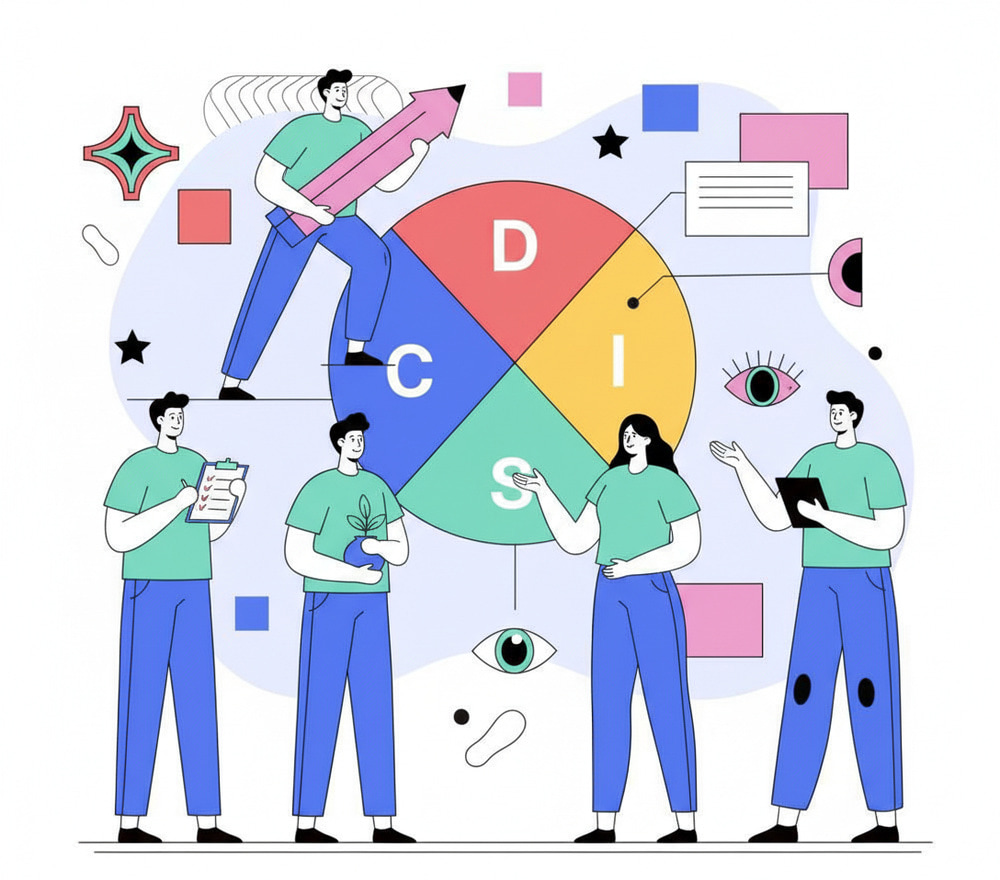
As coaches introduce the style map, many teams reference the DISC profile wheel to visualize clustering, adjacency, and opposite tensions among styles. The visual teaches contrast more effectively than long descriptions, because proximity reveals which behaviors feel natural and which require extra energy. That insight helps people plan recovery time when work demands stretch them away from their default approach. It also discourages stereotyping by showing that every person blends multiple tendencies in different proportions.
Context matters in job design, and the DISC workplace profile connects day-to-day requirements with behavioral preferences to reduce role friction. For fast-moving sales pods, decisiveness and social energy often help accelerate outcomes, while quality teams may lean into pacing and precision. Neither is better in absolute terms, because effectiveness is situational and goals dictate the mix. When teams honor these trade-offs, they stop arguing about style and start optimizing for fit. That shift protects morale and improves delivery by putting the right people in the right moments.
Four Style Tendencies At a Glance
- Dominance: Direct, bold problem-solving that values quick progress.
- Influence: Relational energy that rallies people and builds momentum.
- Steadiness: Patient collaboration that stabilizes processes and teams.
- Conscientiousness: Analytical rigor that raises quality and reduces risk.
Benefits for Teams, Leaders, and Culture
Organizations want tools that earn their keep, and a behavior-based model should translate into tangible outcomes. Leaders use style insights to design meetings that surface the right voices at the right time, reducing interruptions while preserving speed. Facilitators tailor agendas, adding time for reflection when a group skews fast, or injecting rapid decision frames when a group skews methodical. These micro-adjustments accumulate into durable improvements in throughput and satisfaction.
When groups reflect together, the DISC profile analysis creates a safe path to talk about real habits without blaming individuals. Team retrospectives get sharper because observations focus on patterns, not personalities. Hiring panels align on role demands and interview prompts, which cuts bias and improves selection. Sales managers map style dynamics across territories, balancing hunter energy with farmer patience to stabilize pipelines. In customer success, style awareness de-escalates tense conversations by matching pace, tone, and detail to the client’s comfort zone.
| Use Case | Primary Benefit | Action You Can Take |
|---|---|---|
| Hiring and Selection | Better role fit | Align interview prompts to behavioral demands |
| Team Meetings | Improved participation | Balance fast decisions with reflection time |
| Sales Enablement | Higher conversion | Match message pacing to buyer preferences |
| Change Management | Faster adoption | Sequence communications for clarity and confidence |
Deeper organizational impact arrives when HR partners test hypotheses through pilots and practice DISCiplined iteration. In that process, the DISC personality profile assessment supplies consistent behavioral data that can be tied to training, engagement, and performance metrics. Culture committees can track collaboration friction by function and then adjust onboarding to close gaps. Operations leaders can revise standard work to fit team preferences without sacrificing outcomes. Over time, the compounding effect looks like fewer misfires, more predictability, and stronger cross-functional empathy.
How to Take Assessments and Interpret Scores
Good measurement starts with purpose, because people answer more accurately when they know how results will be used. Before any survey, clarify what decisions the data will inform and how confidentiality works. Communicate that style indicators describe tendencies in a specific context, and scores are not judgments of character. That framing keeps respondents engaged and protects psychological safety across the process.
For individual clarity and team calibration, the DISC profile assessment offers a practical starting point and a common vocabulary. Results typically include a primary style, secondary influences, and situational patterns that shift under stress. Review narratives with a coach or manager who can connect findings to real tasks. Consider recent projects and pinpoint when behavior aligned with strengths and when it clashed with demands.
When selecting tools, evaluators often ask whether a shorter quiz or a richer instrument will better serve the goal, and the DISC profile test is most useful when paired with debrief conversations. Self-report data benefits from external observation because others notice patterns we miss in ourselves. Usage improves when teams normalize follow-up questions like, “How can we shape this meeting so you’re at your best?” That culture turns results into action instead of paperwork.
For longitudinal tracking, HR teams sometimes standardize on one vendor to maintain comparability across cohorts, and the DISC profile testing process should include periodic refreshers so people can reflect on new responsibilities. Over time, shifts in role scope can change the cost of certain behaviors, which alters preferences in practice. Regular reviews prevent stale assumptions from hardening into myths. The goal is to keep insight alive so it continues to support outcomes.
- State the purpose and scope before inviting participation.
- Debrief results with concrete examples from recent work.
- Translate insights into one small habit change per person.
- Revisit patterns after major role changes or team reshuffles.
- Protect confidentiality to sustain trust and candor.
Practical Implementation, Costs, and Free Options
Rolling out a behavior model is easier when leaders treat it as an operating system rather than a one-off training. Start with a pilot team, integrate language into agendas, and add style cues to project briefs. Encourage peers to make explicit requests like “I need two minutes to reflect before I reply,” which normalizes preference diversity. Over a quarter, these rituals compound into cleaner collaboration and stronger accountability. Budget often drives adoption sequencing, and many teams begin exploration with a limited resource approach where a free DISC profile option can introduce basic language before investing in deeper tools. Early exposure builds curiosity, and leaders can decide whether the signal-to-noise ratio justifies broader rollout. Pair introductory resources with facilitated DISCussions that turn theory into practice. That bridge helps teams experience value quickly and sets the stage for a more robust program.
When comparing providers, procurement should weigh reliability, clarity of reports, and the user experience, while a DISC profile test free alternative might serve as an entry point but not the long-term standard. Free tools can be helpful for awareness, yet they vary widely in quality and interpretive depth. A measured approach is to pilot with a small group, gather feedback, and choose one system for consistency. This minimizes confusion and reduces retraining costs later. Leadership development often benefits from cohort learning, and your L&D team may combine workshops with coaching where a free DISC profile assessment introduction prepares participants for richer debriefs. That sequencing keeps costs in check without sacrificing learning momentum. Document outcomes, such as faster decisions or fewer rework cycles, to build a business case for continued investment. Over time, the practice becomes self-reinforcing because people taste the benefits in daily work.
FAQ: Common Questions About the DISC-Based Approach
What does this model actually measure?
It focuses on observable behavior and communication preferences, not intelligence, values, or clinical traits. The framework translates how someone tends to act under typical and stressful conditions, which makes it practical for teamwork and leadership.
Can someone’s style change over time?
Tendencies are relatively stable, yet expression shifts with role demands, skills, and environment. People also build adaptability, so the behaviors they practice frequently can become easier and more natural.
Is this tool valid for hiring decisions?
It can inform structured interviews and onboarding, but it should not be the sole basis for selection. Use it to clarify role demands and behavioral success factors, then combine with job-relevant evidence and validated methods.
How should teams debrief results together?
Set ground rules, emphasize psychological safety, and invite examples from real work. Turn insights into experiments, like adjusting meeting cadence or handoff protocols, and revisit outcomes in a month to see what improved.
What’s the best way to sustain the benefits?
Embed shared language into rituals: agendas, feedback, project briefs, and retrospectives. Train managers to ask for preferences, and measure impact with concrete metrics like cycle time, quality, and stakeholder satisfaction.